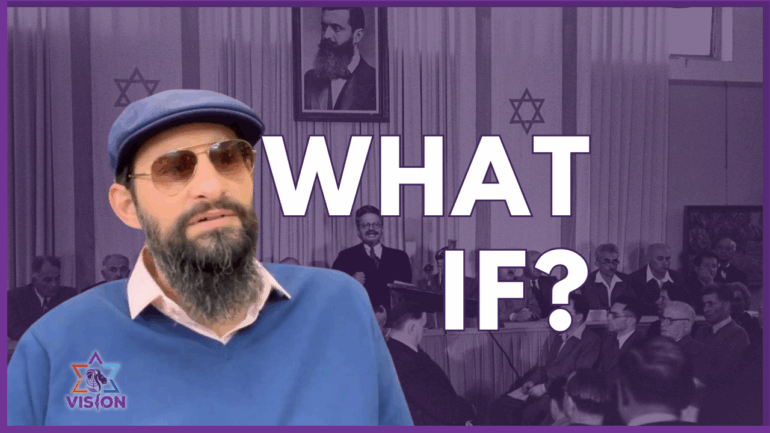
It’s been said that towards the end of his life, Leon (Lev) Trotsky had been developing a Jewish national consciousness.
His exile from the Soviet Union and the anti-Semitic undertones of Joseph Stalin‘s campaign to demonize him may have led the legendary founder of the red army to revisit the “Jewish Question” and explore his own roots.
It’s also been reported that Trotsky began to rethink his attitude towards the Zionist project. The revolutionary had fiercely opposed Zionism in his younger days due to three main reasons:
1. Zionism’s aims appeared to be unfeasible.
2. The Zionist leadership had a policy of collaborating with the imperialist powers.
3. Zionism was antagonizing the native population of Palestine.
By the end of Trotsky’s life, however, Zionism no longer seemed as unfeasible as it had in earlier decades.
The task of moving a scattered population of Jews from the ends of the earth back to the homeland they had been displaced from centuries earlier was being carried out with astonishing success.
The many challenges to reviving an ancient language back to everyday use had largely been overcome.
Once meek and bookish Jews were learning to become farmers and soldiers and laborers.
Under the British colonial system, the Zionist leadership had created the infrastructure for a future state.
Had Trotsky not been assassinated in 1940, perhaps he would have found his way from Mexico to Palestine.
Even had Trotsky made the journey to Palestine for a closer look, it’s unlikely that he would have been able to stomach the Zionist movement’s love-hate relationship with the British colonial regime or with frequent attempts by Zionist leaders to present their objectives as aligned with British imperial interests.
But Trotsky might have been drawn to the anti-imperialist rhetoric and revolutionary actions of the Loḥamei Ḥerut Yisrael (Fighters for the Freedom of Israel) – or Leḥi – that had rejected Zionism and declared war against the British Empire at the start of World War II.
Leḥi founder Yair (Avraham Stern) had a background in Leninist political theory, having lived with his Bolshevik uncle in Petrograd at the time of the revolution and having been educated in the All-Union Leninist Young Communist League. He was therefore able to identify British imperialism as the primary barrier to Jewish national liberation.
At a time when Trotsky’s predictions regarding the threat of Fascism had come to fruition and the British had shut the gates of Palestine as Jews in Europe were being slaughtered on a mass scale, it makes sense that he would seek to actively join the fight against imperialism.
Because the Sternists of Leḥi were officially non-Zionist, anti-imperialist and even sought solidarity with the other peoples of the region (there were even Arab Sternists from villages like Abu-Ghosh), Trotsky would have certainly felt more comfortable with this formation than with the rightist Irgun Zvai Leumi (National Military Organization) that had joined the anti-British struggle in 1944. And given Trotsky’s international notoriety and successful revolutionary background, it’s likely that the Sternists would have given him a leadership position in directing their urban guerrilla war.
Based on his experiences, Trotsky would have been unlikely to relinquish power to the Zionists once the British were defeated. As leader of the underground faction most responsible for liberating the country, he might have settled for nothing less than becoming the newly freed nation of Israel’s first head of state.
The State of Israel would have certainly developed differently under Trotsky’s leadership. Rather than side with oppressor nations, as the Mapai-led government did in its quest for superpower patronage, Trotsky’s Israel would have likely sided with the oppressed of the world (but it’s unlikely in this scenario that Israel would’ve received the arms shipments it did from Stalin in 1948).