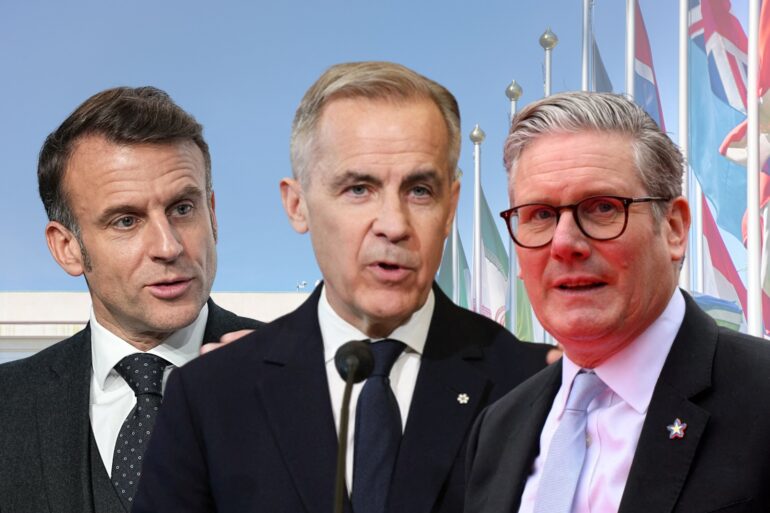
French President Emmanuel Macron recently triggered a domino effect of Western governments declaring intentions to recognize a Palestinian state in parts of our land.
Canada followed swiftly. Then came British Prime Minister Keir Starmer, issuing an ultimatum to end our war on Hamas or they’ll recognize a Palestinian state.
But for all the noise in Western capitals, the borders they seek to impose are recognized by neither Jews nor Palestinians between the river and the sea.
Zionist voices in Israel and abroad swiftly condemned the move.
Diaspora Affairs Minister Amiḥai Chikli (Likud), tweeted the infamous video of Macron being slapped by his wife aboard a plane in Vietnam, writing: “Here is the appropriate response to your recognition of a Palestinian state as a reward for Hamas terrorism.”
Opposition leader Yair Lapid (Yesh Atid) struck a more diplomatic tone but was no less firm: recognizing a Palestinian state without assurances or preconditions, he warned, is reckless and irresponsible.
These reactions reflect the overwhelming unpopularity of the two-state paradigm in Israeli society. But more than that, they reveal something deeper: the structural limitations of Zionist ideology itself.
Every Zionist condemnation of Palestinian statehood comes with some caveat. Because Zionism, as an ideology, seems unable to straightforwardly oppose the partition of our land without undermining its own moral foundations.
Zionism, as both a response and product of the Haskala, is the belief that Jews are a people with the right to national self-determination in our historic homeland. But if national self-determination is a universal right, how can Zionism deny that same right to Palestinians?
To maintain coherence, Zionists must adopt one of three stances:
- Deny Palestinians peoplehood.
- Support Palestinian statehood within our land alongside a Jewish one.
- Oppose Palestinian statehood by appealing to claims of security needs or moral and civilizational superiority.
In practice, most Zionist voices choose the third route. They frame the prospective Palestinian state as a terrorist threat or a future Iranian proxy. These are not merely security concerns, but the very means by which Zionism justifies denying to others what it claims for itself.
But in doing so, Zionism exposes its own inconsistency.
If the Jewish state is a right, how can the Palestinian one be a threat? And if the Palestinian one is a threat, is the Jewish one not also conditional and dependent on being more liberal, more Western, more moral than its imagined counterpart?
This is not a new problem. The earliest Zionist leaders saw it coming. Herzl believed international recognition was essential to statehood. Weizmann fought to make that recognition a reality.
When the 1937 Peel Commission offered a partition plan, many Zionists supported it because they saw it as at least legitimizing the notion of Jewish statehood. The commitment to or against partition was always provisional, never principled within the bounds of Zionist ideology.
The irony is that the same Western powers that Zionists now criticize for recognizing a Palestinian state are the ones that historically enabled the Zionist project. It was Britain’s Peel Commission that first proposed partition (although Jews had to ultimately fight the British to drive them from the country). It was the United Nations that endorsed the creation of a Jewish state (although that resolution had no teeth and was merely a recommendation in its own language).
Now, when these same powers stand squarely against Israel, Zionist leaders cry foul. But how can one challenge Western imposition while relying on Western endorsement to justify one’s own existence and borders?
The Zionist political spectrum—from liberal to revisionist —operates within the ideological range permissible to the Western liberal order. Its policies must appeal to Washington, London, Ottawa, and Paris.
Even US President Donald Trump and Canada’s opposition leader Pierre Poilievre have taken up the Zionist caveats: yes to Israel, no to unilateral Palestinian recognition.
This is not ideological support so much as a reflection of Zionism’s inability to speak outside the terms of Western liberal ideology. We can only wonder where these “friends” would stand if Israel were to embrace an identity that’s both more overtly Jewish and more in line with our neighbors in the region.
This reveals the deeper problem: Zionism has not produced a truly sovereign Jewish political identity. Its vision of Jewish nationhood has always been filtered through the frameworks of European nationalism and colonial legitimacy. And in that, it has failed to develop an indigenous and self-sufficient paradigm of political independence, justice, and governance in this land.
The foreign framings we limit ourselves to have prevented Jews from imagining a different future. If Palestinians cannot have a state because they lack the (liberal Western) moral code to do so, Israel’s legitimacy relies on flawlessly upholding that moral code.
The “two-state solution” is dead not because Palestinians “aren’t ready for it” as Israeli officials often claim — but because it’s a Zionist solution marred in contradictions.
A Palestinian state anywhere between the river and the sea could solidify a truncated Jewish majority state and allow Israel to remain a liberal Western state, keeping its contradictions non-antagonistic.
From a Palestinian perspective, the two-state model would be a Zionist victory in which a “colonial” actor gains legitimacy.
Palestinians have also had a very narrow identity and set of aspirations imposed on them by the two-state paradigm. We see this reflected in sarcastic pro-Israel remarks suggesting that Palestinians can have their state in French and British colonial territories; an ironic echo of the various proposals for the Zionist Jewish state in Herzl’s day.
For Palestinians, Zionism obviously misses the mark. But it also misses that mark for an increasing number of Jews.
These cracks in the Zionist worldview point to the need for something new: a framework that is not held hostage to Western approval, that does not rely on inherited European categories, and that does not demand moral double standards to justify its existence.
Such a vision would not pit Jewish and Palestinian futures against one another but would seek a political reality in which both peoples live as partners building this land, while maintaining our respective tribal identities and protecting each other from the forces of empire.
A movement that draws from Herzl’s yearnings but also from the deep wellsprings of Jewish prophetic tradition, Palestinian steadfastness, and regional belonging.
Zionism, in its current form, cannot solve the conflict. It cannot even imagine a workable solution. Its caveats, contradictions, and dependencies have rendered it intellectually and morally exhausted.
It is time to move beyond Zionism. In truth, maybe we already have.
Perhaps the recent increase in Israeli opposition to partitioning our country comes from a deep sense of belonging to this land and a rejection of colonial framings.
Now we simply need to develop a new political language.