
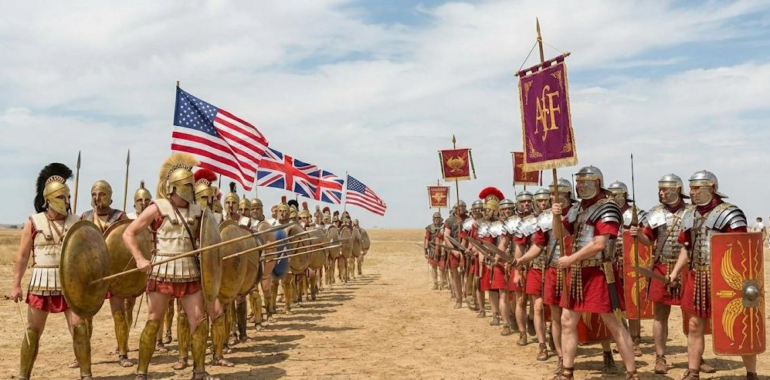
A battle of ideas is raging in the West between two ideological camps that are fighting to be “the true right.”
While figures like Douglas Murray and James Lindsay continue appealing to enlightenment ideals of basic human equality, democracy, and liberal-capitalist individualism, their intellectual adversaries like Tucker Carlson and Nick Fuentes are leaning into a deep-seeded tribalism, grounded in an interesting blend of Christian moralism and white nationalism.
While many have been shocked by these developments on the right, blindsided after years of focusing on left-wing anti-Semitism and anti-Zionism, our prophets and sages have been shedding light on these conflicting forces within the West and their unique antagonisms towards Israel for millennia.
Hebrew historiography identifies four empires that have contested Israel’s influence over humanity throughout history: Babylon (Bavel), Persia (Paras), Greece (Yavan), and Rome (Edom).
In his book Ner Mitzvah, the Maharal of Prague gives particular focus to the later two, and their historical conflict with Israel. He teaches that Yavan embodies intellectual threats to Israel, typified by Greek philosophy, which seeks to reduce Israel’s prophetic Torah to just another philosophy in the market of ideas.
As part of this trajectory, the Greeks highlighted the sin of the golden calf as demonstrative of Israel’s incidental connection to the Divine will, the commandments, and the Torah, not different from the Greek’s surface-level connection to their varied schools of philosophy.
Ḥanukah commemorates Israel’s ideological rejection of this paradigm, and our emuna that Israel’s connection to prophecy and to the Creator is eternal and unwavering, even if we don’t necessarily live up to our Divine potential in every generation.
In our current chapter of history, the force of Yavan is expressed most explicitly through the notion of “Judeo-Christian” values and the concept of a shared Western civilization of which Israel is a part.
Just as Yavan demanded that our sages translate the Torah into Greek so that they could include it in their philosophical canon, these modern thinkers apply their ideological frameworks to Israel’s culture and politics in order to emphasize our commonalities. This phenomenon is especially common within Protestantism, which in rejecting Roman Catholic hegemony, aimed to democratize the church by translating the Bible into Europe’s vernacular languages.
But while Evangelical Christian-Zionists focus on shared theological foundations, atheist intellectuals like Murray and Lindsay focus much more on political philosophy. While they might appreciate the Jewish people’s more traditional social values when it comes to issues like family and patriotism, they remain faithful to the liberal ideological paradigm of the modern West, and see representative democracy and capitalist individualism as the ideal organizing principles of society.
But conservative critics like Yoram Hazony (a key influence on US Vice President JD Vance’s political philosophy) argue that by nature, liberalism undermines traditional ties to nation and family by essentially treating all members of the body politic as uniform blank slates. Just as the Greeks and the early Christians after them wished to approach Torah as a blank canvas, interpreting it as fit their own worldview, and selectively choosing what to observe and what to discard, “liberal” societies have historically asked outsiders to check their identities at the door in order to gain acceptance.
It’s easy for Murray and Lindsay to latch onto Israel as an exemplar for the society they want to build, because Israel is still in the process of defining for ourselves what kind of society we’re going to be. But when we fully step up to fulfill our historic mission, will Lindsay condemn our radical socioeconomic policies as “woke-left” or our intolerance for idolatry as “woke-right”?
The ambiguity of Israel’s complex identity was already apparent nearly a decade ago when Richard Spencer stated in 2017, “You could say that I am a white Zionist in the sense that I care about my people. I want us to have a secure homeland for us and ourselves. Just like you want a secure homeland in Israel,” and calling Israel the “most important and perhaps most revolutionary ethno-state, and it’s one that I turn to for guidance.”
Since then, the white nationalist right’s relationship with Israel has been full of contradictions.
While there’s a certain degree of admiration, like in the case of Spencer, it’s typically a technical admiration: “Why aren’t we doing what they’re doing?”
In practice, “doing what they’re doing” quickly leads to calls to “send them all back to the Middle East.”
As the Ramban explains in his commentary on B’reishit 32:9, Edom generally doesn’t desire to completely annihilate Israel as Persia attempted. Rather, the Fourth Empire historically oppresses us in one of its territories while allowing us to flee to other territories under its dominion. Here too, it seesm the far right believes that Western civilization can be saved, not by annihilating the Jews, but by enforcing a principle of “Israel for the Israelites, America for the Americans.”
But over the course of Israel war in Gaza, the Christian roots of the far right have complicated this dynamic.
In their critiques of Israel’s war, the false Christian morality of “turning the other cheek” and “loving your enemy” has superseded “just war theory” – reflecting a reversal of the trajectory of church doctrine’s development.
Whereas the earliest Christians, due to their powerlessness under the pagan Roman Empire, emphasized radical pacifism as a religious doctrine in order to survive, once the empire converted and the Church coopted the power of Rome, Edom’s “blessing” to “live by your sword” took precedence and the Church Fathers developed “just war theory” as a proto-legal framework to justify Christian monarchs pursuing military campaigns.
When accusing Israel of “prosecuting a genocide in Gaza” and claiming that “it is reprehensible to any Christian to support what Israel is doing in Gaza right now” they lean into early-Christian pacifism, but when glorifying Stalin for being a “winner” and Hitler for “going hard,” they appeal to the realist necessity to advance an agenda, even if that means dirtying their hands with moral ambiguities.
This duality of glorifying or downplaying mass violence committed by atheists (even if done semi-ironically to be edgy) while painting Israel as uniquely evil for prosecuting a just war according to Augustinian principles betrays a much deeper truth.
Ultimately, “it’s about Jacob and Esau, it’s about the Jews and the nations, it’s a cosmic battle.”
Our sages tie Esav’s bitter cry here to Mordekhai’s cry over the genocidal decree of Haman in the Purim story.
Esav’s bitterness towards Israel’s blessing, even on the battlefield, breeds a cynical attempt to deny us the sword that Esav and his descendants so expertly wielded against us across the ages. Edom cannot accept that Israel “will also be blessed” as a nation reborn on the stage of history. The fundamental contradiction we represent – the return of Avraham’s true biological and ideological descendants to the promised land – must therefore be eliminated.
As the Maharal writes, “the Fourth Empire… because it sees itself as everything (a characteristic that derives from its universality) desires that nothing else should exist. It therefore destroys all others and is occupied with destruction only.”
Israel’s rebirth, through all of its political struggles and brutal wars, is a beacon of the eternal Divine truth that Edom’s all-consuming political universalism can never accept.
By recognizing the competing and contradictory layers within Edom – annihilation, expulsion, and emulation – and the complex interplay between them, we can better respond to their attacks, both physical and ideological, by recognizing what Israel truly is and why that frightens them so much.
But if we trick ourselves into thinking that we can win this war by submitting ourselves to Yavan, and adopting the moderate conservative critique of the far-right, we’ll likely find ourselves in even deeper trouble, as the meta-historical necessity of Edom’s counterpoint forces us to shake off the yoke of foreign ideologies and truly embrace our destiny as a people.




Aryeh Leib, thanks for that needed deep dive and for coming back to a fundamental truth: Ultimately, “it’s about Jacob and Esau, it’s about the Jews and the nations, it’s a cosmic battle.” That linked Fuentes clip is beyond fascinating.
Sorry but I have difficulties following your argumentation: At the beginning I guessed that you favour the “enlighted”, atheist, materialist, capitalist fraction of Edom represented by MURRAY and LINDSAY over the “bigott”, tribalist/nationalist fraction of CARLSON, FUENTES, SPENCER ? But at the end I was not so sure anymore … could you please clarify who are the “good guys” (if at all) in Edom and who are less ?
Thanks for your feedback – “Edom” – the “tribalist/nationalist faction is definitely the more immediate danger to Jewish safety. But I argue that in the long term, “Yavan” is dangerous to our identities if we let ourselves believe that we’re fighting the same fight for the same principles.