What was the prophet Yonah thinking?
Why did he try to flee instead of observing the direct command given to him by the Creator to make a proclamation to the city of Ninveh?
Can his objections really be limited to the well-known consideration that since “gentiles are close to tshuva” their repentance will serve as a basis to criticize the children of Israel?
Did not Yonah want, like all the Israelite prophets, to improve the entire world?
Perhaps the answer is that Yonah was upset by the shallow nature of the repentance that might be expected from the people of Ninveh. It would be nothing more than a surface-level caricature of real tshuva.
The people of Ninveh clearly acted out of a sense of fear, not out of love for HaShem. But they did not even act out of a proper fear, which should lead to an ethical modification of the soul, but rather out of a mere fear of a physical danger that must be removed.
But even so, this superficial repentance was accepted by the Creator. Ninveh was given an extension and, later on in history, they destroyed the Kingdom of Israel.
Despite the logic of this explanation, there is absolutely no hint of it in the actual text. The straightforward reading of Sefer Yonah implies that Yonah objected to the basic principle of that the tshuva of the nokhri should be accepted.
“That is why I had fled to Tarshish. For I know that You are a compassionate and gracious G-d, slow to anger, abounding in kindness, renouncing punishment.” (Yonah 4:2)
In this list of the Creator’s traits, Yonah leaves out the characteristic “truth” which appears in the similar list of Divine traits in the Torah (Sh’mot 34:6).
Yonah’s very name shows that just like a dove (a “yonah“), he is faithful to his mate and to the truth. He is also the son of “Amitai” – from the word “emet” (“truth”).
The trials that we see Yonah put through are all intended to give him a greater love for life, to balance his love for truth.
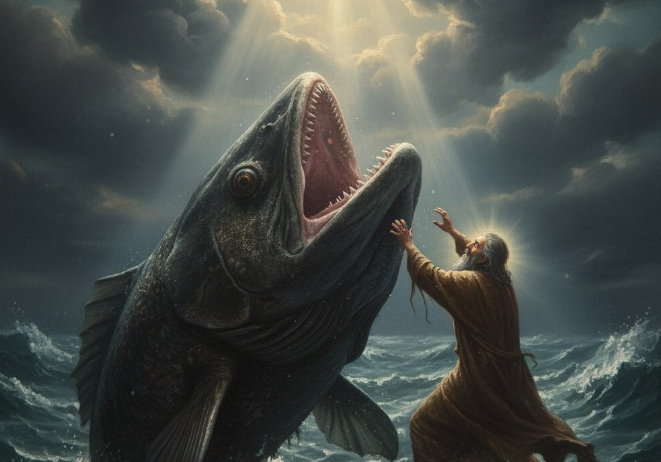
First, the storm is an expression of the living power of the sea. This is followed by a great fish that swallows him – a living creature that protects him from death.
Then there is the pregnant fish with hundreds of embryos (Rashi on Yonah 2:1). And finally he is protected by a Qiqayon (castor oil plant), which makes him very happy. For life to exist, it is necessary for there to be a large measure of mercy.
“If you want judgment, the world cannot exist. If you want a world, there can be no true judgment.” (B’reishit Rabba, Vayeira)
The logical inference of a “kal v’ḥomer” is also used to convince Yonah to accept the legitimacy of the trait of mercy.
“You had pity on the Qiqayon… Should I not have pity on Ninveh?” (Yonah 4:10-11)
At this point, the book of Yonah ends without any response by the prophet. One who insists on the supremacy of truth, as opposed to the desire of the Creator to accept those who repent, has no answer.
In the Maftir reading for Yom Kippur, our tradition fills in what is missing by adding the “Thirteen Attributes of Mercy” listed in Sefer Mikha, almost as if Yonah had recited them. As is written, “Yonah immediately prostrated himself on his face, and he said, rule Your world with the trait of mercy.” (Yalkut Shimoni on Yonah 4:551)
We see here that tshuva is so great that it can even take precedence over the attribute of truth – so that the world will continue to exist.
(With thanks to Rav Yosef Aton for some of the above ideas)
Translation by Dr. Moshe Goldberg