

Kibbutz Ayelet HaShaḥar in 1969 was an appropriate place for an 11-year-old to gain a sudden insight as to how the world should work.
It was our first visit to Israel and my family was taken to the bomb shelters where two years earlier, prior to the Six Day War, the children of the kibbutz slept every night due to the shelling from the Syrian gunners on the Golan Heights. And we saw the agricultural fields where Syrians would take regular potshots at the farmers below. And we viewed the Kineret (Sea of Galilee) where Israeli fishermen would serve as targets for Syrian artillery.
And then in 1967 things miraculously changed.
The Syrian bullies of the hills were toppled and Kibbutz Ayelet HaShaḥar of the Northern Galilee, founded in 1916, went on to become one of Israel’s largest fruit and honey producers, with fish farms, a dairy industry, hotel, and so much more.
I hated the game “King of the Castle.” I was so clumsy that on a good day I could barely make it up the hill – only to be pushed down. So, at the ripe old age of 11, it occurred to me that the vicious ones should be at the bottom of the heights and the productive, creative, and non-violent individuals (and nations) should rightfully be on top. It just made sense. It seemed ethical, “Abrahamic” if you will.
Thirty years later, I learned my first Rashi, which just happened to be the first Rashi, which just happened to coincide with my worldview. Penned in France in the 11th Century, deep in the Diaspora, a landless Rabbi Shlomo Yitzḥaki had this to say:
“Why does the Torah begin with ‘In the beginning…?’ …For should the nations of the world say to Israel: ‘You are thieves, because you conquered the lands of the seven nations of Canaan,’ Israel may reply to them: ‘All the earth belongs to the Holy One, Blessed be He. He created it and gave it to whomever He saw fit. By His will He gave it to them, and by His will He took it from them and gave it to us.” (Rashi, B’reishit 1:1)
Israel is now firmly planted in this region, not as a settler-colony or as an aggressive superpower, but as a small but formidable eternal nation to be reckoned with – tasked with distinct personal and universal obligations and responsibilities.
Now this poses a problem for “the greatest” and most triumphalist powers and faiths in the world. How do nations largely influenced by the principles of fundamentalist Christianity and Islam reign in and tame the rising lion of Judah?
From Israel’s perspective and with geo-political developments gone wild, it’s high time we reassess the restraints placed upon us by those who lay claim to the supreme truth and wield it over others.
A recent analysis in Vision Magazine rightfully suggests that, given recent dramatic changes in the region, it’s necessary to revisit the logic of Abraham Accords in their original form and what the potential value of an expanded version might be at present.
A second piece calls for a complete abandonment of the Abraham Accords due to the UAE’s “unhealthy” perception of “Israel as a vassal of the United States rather than as an independent player on the international stage... likely rooted in a broader Arab unwillingness to accept the reality of Israel’s new status as the regional hegemon in West Asia.”
We can only hope that the Emirate’s diplomatic jousting over Palestinian territorial rights doesn’t graduate into a more serious degree of saber rattling.
But in addition to a necessary strategic re-evaluation, I would also suggest an ethical review, as there is something grossly inconsistent and oxymoronic about the very spirit of these accords.
The Abraham Accords Declaration, or at least the opening page preamble, is couched in hopeful verbiage ad nauseam. I imagine it’s standard practice for diplomatic interns to comb through every optimistic synonym in a thesaurus in order to utopianize these types of agreements. A very abridged sampling follows:
“We, the undersigned, recognize the importance of maintaining and strengthening peace in the Middle East… based on mutual understanding and coexistence…. respect for human dignity and freedom, including religious freedom... promote interfaith and intercultural dialogue to advance a culture of peace among the three Abrahamic religions and all humanity... cooperation and dialogue and developing friendly relations… interests of lasting peace… tolerance and respect for every person… make this world a place where all can enjoy a life of dignity and hope, no matter their race, faith or ethnicity... inspire humankind, maximize human potential and bring nations closer together... pursue a vision of peace, security, and prosperity in the Middle East and around the world.”
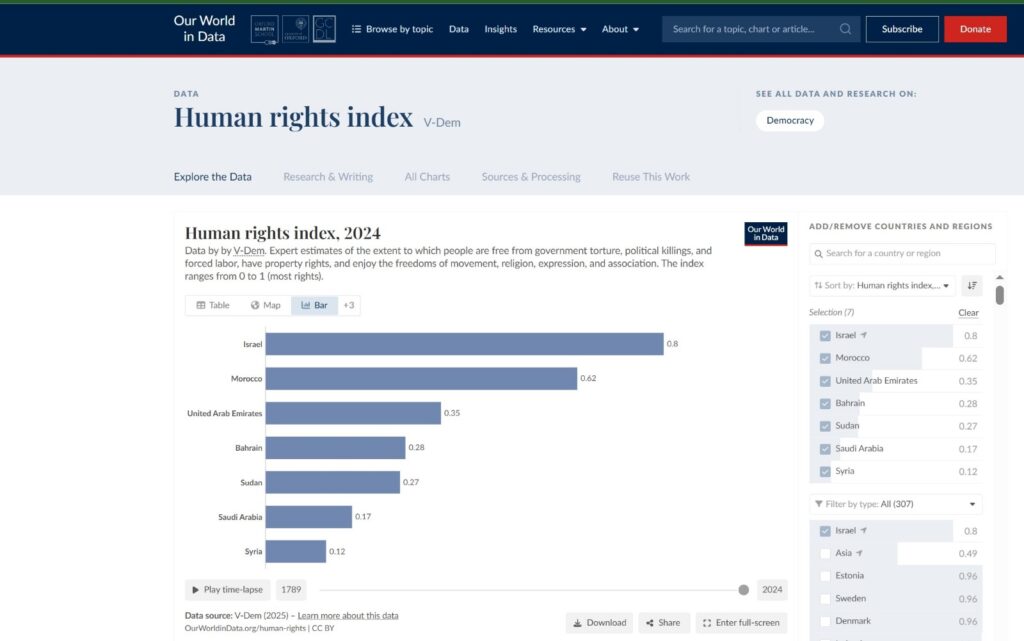
I suppse there’s nothing wrong with that, except when you take into consideration how poorly the countries involved in the Abraham Accords score on the 2024 Human Rights Index at Our World in Data (a collaborative effort between researchers at the University of Oxford).
The rosy picture of the accords quickly morphs into the impossible dream and “fake news.” The United Arab Emirates (UAE), Bahrain, Sudan, Saudi Arabia, and Syria hit rock bottom on “the extent to which people are free from government torture, political killings, and forced labor, have property rights, and enjoy the freedoms of movement, religion, expression, and association.”
Morroco would be an exception, with a mediocre rating, and Israel enjoys a decent score.
But what some of these nations lack in humanity, they more than make up for in crude oil. And in this world, the economy trumps humanity. Having his name attached to these agreements might have caused our ancestor Avraham some discomfort because, although prosperous, greed and a lust for riches was not among the outstanding character traits of our forefather.
Indeed, once you get to the actual signed treaties, much of the embellished humanistic language of the opening Declaration of the Accords, gives way to, or is subjugated by, understandings overwhelmingly addressing finance, investment, trade, economics, and access to air space.
The Palestinian cause and a call for a solution is also a prominently featured in the signed agreements between Israel, the United States, the UAE, Bahrain, and Morroco.
At this point, Avraham may be covering his head with ashes, as some of our sages suggest that our ancestor’s treaty with Avimelekh, the Philistine king of Grar (in Gaza), angered the Creator in a big way. Avraham made a pact over territory that was assigned to his posterity.
The Trump administration, increasingly flexing its Christian nationalistic muscle, is touting the accords as promoting religious freedom. But on whose terms? Ever since the Congressional International Religious Freedoms Act of 1998 went into effect, Israel is regularly called to task in the annual State Department Religious Freedoms Reports for challenging Christian/messianic missionaries and their proselytizing efforts directed at Jews in Israel.
I once asked historian and author Professor Richard Landes for his views on this direct challenge to Israel’s identity:
“Given that the US began as an overwhelmingly Christian nation, and Christianity is a quintessentially missionary faith, it would have been hard for American notions of religious freedom not to have included the right to missionize.”
But the US Ambassador to Israel, Mike Huckabee, is also a devout Baptist pastor who has over the years consistently endorsed aggressive missionary organizations in Israel and continues to do so. A stunning example follows:
“The best thing to happen for Israel is that the Gospel would take hold in both Israelis and in Arabs… and it would not be something that diplomats would have a clue about. It would be something that would happen not at a peace table, but rather at the foot of the cross.”
In 2016, Huckabee praised the missionary organization “One for Israel Ministries” – saying that they “use biblical truth and fact to bring people to the point where they realize who the messiah is and how Yeshua is the fulfillment of all of the prophecies.”
Avraham, the legendary destroyer of idols, could ironically find himself in a legal quandary today. Avraham the Hebrew would likely be perplexed by the contemporary West’s religious freedoms liberties and all it entails for his children – the people of Israel.
Baked into the Accords
The building blocks and foundations of the Abraham Accords, as well as other agreements frequently emanating from Washington, are shaky from the get-go.
Couched in Western context and culture, there has been a neutering, genericide and appropriation of definitions applied to terms and phrases such as “anti-Semitism” and “genocide” and “religious freedom” and the “Abraham Accords” – named for the founder and progenitor of our people. This has done much to repress Israel’s ability to express ourselves in terms which should be an innate part of our own unique experiences and historical journey as a nation born into the Levant region.
Bereft of spiritual content and historical perspective, the nation of Israel has unjust and near impossible limitations placed upon our freedom of expression when facing any Western-dominated diplomatic arena. Add to this an insensitivity or disregard for our distinct identity as a people (we are decidedly not part of a Judeo-Christian heritage or tradition – regardless of what Ben Shapiro tells you), and becoming a partner in – or signatory on – international understandings, treaties, and accords is a risky venture at best.
But there are Promising Alternatives
There are an abundance of ancient, non-proselytizing, and peaceful survivors in this region, more in sync with the values and visions of our forefathers than the expansionist, aggressive, and powerful players our people have been forced to deal with since the inception of our state.
Druze, Kurds, Yazdis, Armenians, Circassians, Bahai, Karaites, Samaritans, certain Bedouin tribes, and the list goes on. I would think that Israel in now in a unique position to break new ground and form sincere alliances with these groups and establish a precedent for others in the region.
So, this Jewish mother, who finally made it to the top of the hill (yes I live in the Golan ) still thinks like that little girl. And I therefore just don’t get the Abraham Accords.
But my father, Yaakov ben Avraham, z”l – a very wise, successful, and highly principled businessman – would have told me: “Honey, if you don’t understand the plan and it doesn’t feel right, then don’t invest.”
“But the humble shall inherit the land, and they shall delight in much peace.” (Tehillim 37:11)




Hi, Ellen.
I like this article very much, and think you’ll be happy to hear that after our invasion of Doha, Qatar to get rid of the people who planned and executed “October Seventh,” the Abraham Accords are now a thing of the past. However, the Arab countries are now scrambling to get together to war against tiny, minuscule Israel.
Of more concern is the ongoing attempt to turn Israel into a Christian country (comments are closed at the article I read, “There’s a New Church in Town.”). It would do us a lot of good to read and study the book(s) of Samuel/Shmu’el the prophet, who anointed the progenitor of the messianic kingdom family, David, the youngest son of Yishai (if I understand correctly, the Xians turned the one book of Samuel into two.). Understanding the implications of the Scripture here would turn the whole issue into dust and ashes, especially at 2nd Samuel 7, where the prophet Nathan conveyed God’s promise to King David.
I wrote more about this at https://havahaaharona.blogspot.com/2025/07/the-prophet-nathans-words-from-god-to.html. There is no way one can connect Yoshke by any spelling or Xian “scripture” to King David’s male line.