The Torah of Moshe, which appears in Parshat T’ruma (in which Aharon is not mentioned), is geared towards a person who is righteous and controlled by his intellect.
There is no fear that such a person will commit a sin, but he or she needs instructions on how to get closer to the Creator.
The Torah of Aharon, on the other hand, which is featured in Parshat Tetzave (in which Moshe isn’t mentioned), assumes that people might commit a transgression, and that even a sinner is in need of guidance in order to prevent him from descending further downward and to help him to mend his ways.
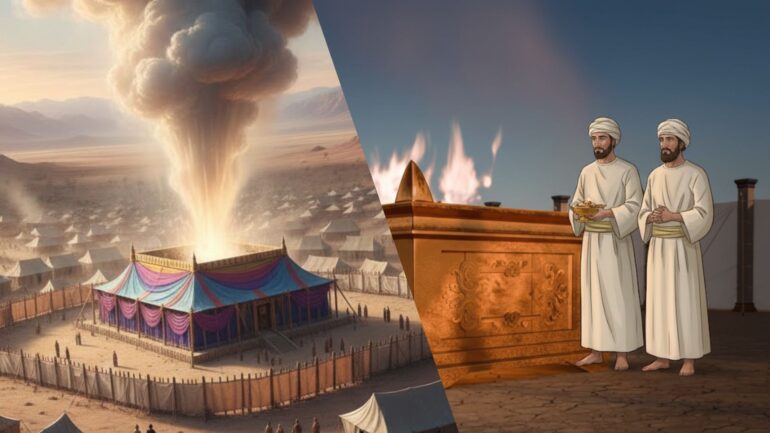
The Mishkan of Moshe, which appears in T’ruma, doesn’t contain any of the implements necessary for atonement – the Kohanim, their uniforms, the incense Altar and the Basin.
The Mishkan of Aharon, which is described in Tetzave, operates on the imagination.
“And you shall make the holy garments for your brother Aharon, for glory and beauty.” (Sh’mot 28:2)
These garments impact the soul.
The Mishkan of Moshe was built supported by contributions from the people, without any need for a direct command. But the funds for the Aharon’s Mishkan was raised in response to a direct command.
According to Moshe’s Torah, the people are inherently good, and there’s no doubt that the people will want to contribute. Aharon’s Torah assumes that people are weak, and that a commandment is necessary to ensure that all the necessary items will be donated.
If the only Torah taught would have been the Torah of Aharon, we might have thought that sin is unavoidable, and that it’s impossible to imagine life without sin. Sin would have become the basis for serving HaShem, as is the case in Christianity. And that is why the model of the Mishkan of Moshe is brought first, telling us that it’s possible for the intellect to take control, and that it’s possible to serve HaShem properly without incorporating the concept of sin.
The proper pedagogical approach is to teach that we are born with the ability to serve the Creator without sin, but that if one does sin, the situation can be fixed.
In order to bring a sinner closer to HaShem, the Torah of Aharon teaches us to descend to the depths of the sin in an attempt to raise it up. This is the path that Aharon followed with respect to the Golden Calf.
In general, we act according to the Torah of Moshe, but a prophet’s order can temporarily suspend a commandment and allow us to diverge from it, and this is also part of Moshe’s Torah.
But today we seem to live in a world without prophesy.
Malakhi, the last of our ancient prophets, ends his Book with “Remember the Torah of my servant Moshe, which I commanded all of Israel at Ḥorev – the laws and the decrees” (Malakhi 3:22).
The prophet makes it clear that in an era when prophecy has been temporarily suspended, the Torah of Moshe must take precedence over the Torah of Aharon. But who then will act to bring the sinners closer to HaShem? The prophet tells us, “Behold, I will send Eliyahu the Prophet to you before the arrival of the great and awesome day” (3:23).
Prophecy will return before the day of final judgment and all the hearts will once again move closer together. The sinners will be given an opportunity to mend their ways, based on the Torah of Aharon, so that they will then be able to stand up for judgment.
Now, in the era of redemption, we have once again begun to return to the Torah of Aharon through the teachings of HaRav Avraham Yitzḥak HaKohen Kook.
The Rav writes: “Behold, I can see the light of Eliyahu rising up.”
The Torah of the era of redemption shows us how to “bring back the hearts of the fathers to the sons and the hearts of the sons to the fathers” (Malakhi 3:24).
Translation by Dr. Moshe Goldberg