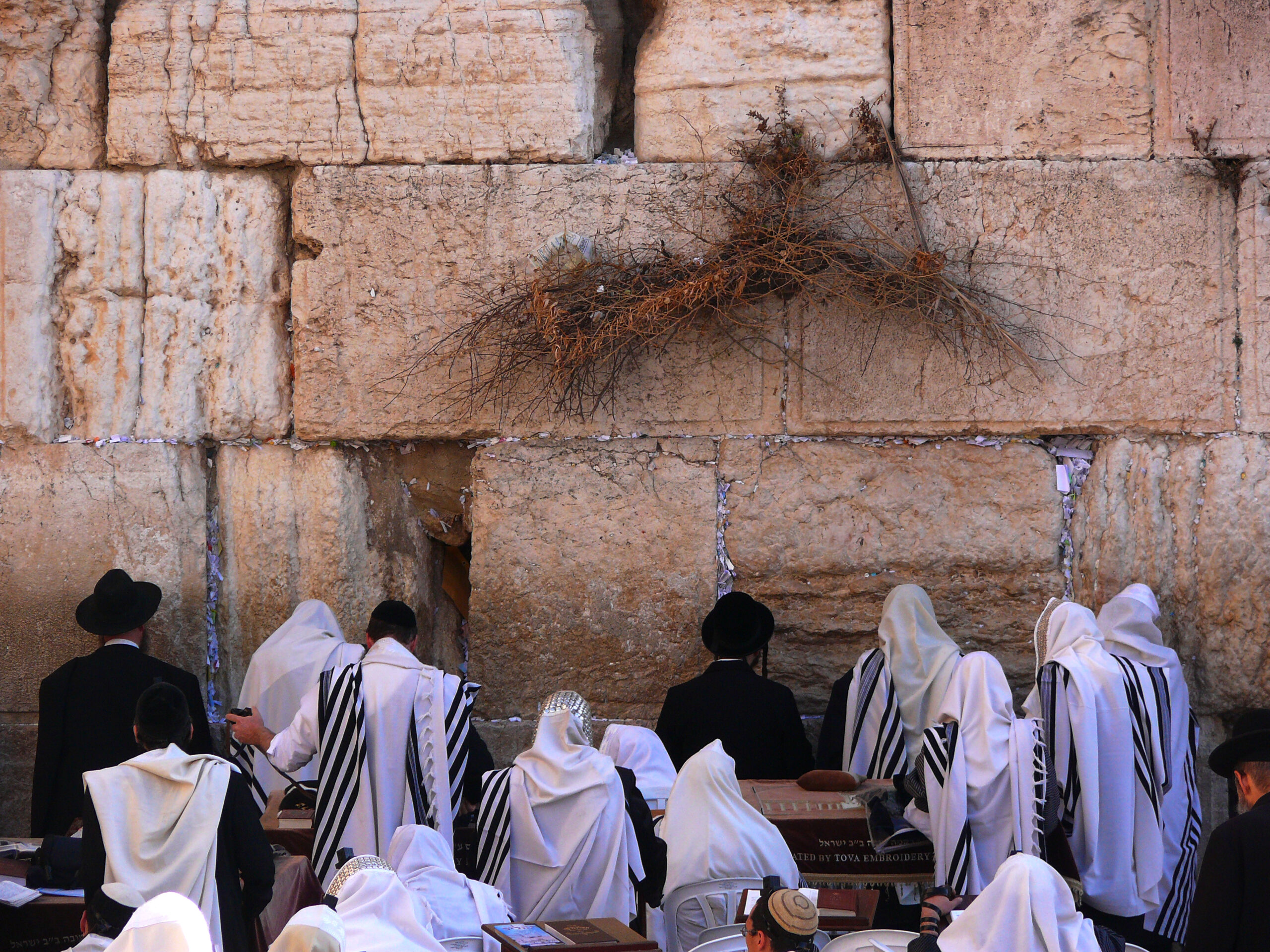
There’s an interesting and rarely talked about connection between the Jewish people’s daily tefillot and our holy days. While both express and reinforce the collective yearnings for personal, national, and universal redemption, there is another, somewhat surprising dimension to their relationship.
The central tefillah of the Jewish people, said three times daily, is the Amida. It was composed over two thousand years ago and contains a series of “requests” that Jews are meant to internalize and focus on. In many respects, this tefillah expresses the mission statement of the children of Israel. It acts as a manifesto that outlines our people’s desires and goals.
The Amida begins with a request for knowledge, repentance, forgiveness, and redemption.
These initial requests line up perfectly with the start of Israel’s external calendar (as opposed to our internal national calendar). Going back to the month of Elul, the last month of our external calendar, building up to the holy days of Rosh HaShana and Yom Kippur, the Jewish people immerse in Torah study and focus on character improvement, seeking forgiveness for past wrongs, and reconciliation. This intense start of the year then culminates with Sukkot and Simḥat Torah; holy days with deep connections to past and future redemptions.
The next focus of the Amida is on healing, agricultural abundance, and a return to the land of Israel.
These themes are interdependent, as are all of the requests of the Amida, in the sense that it requires spiritual, mental, and physical health to irrigate, plant, and overcome the obstacles to developing the land of Israel.
In turn, it requires a fertile and developed land to absorb a global exodus and mass return of the Jewish people.
These tefillot echo the next set of holidays on the Hebrew calendar, Ḥanukah, Tu b’Shvat, and Pesaḥ.[1]
Ḥanukah expresses spiritual healing by emphasizing the importance of creating light during the darkest time of the year. It also connects to spiritual and physical restoration by commemorating the rededication of the Holy Temple after its physical and spiritual defilement.
Tu b’Shvat celebrates the agriculture of our land and reminds us of the prophetic promise that the land of Israel only grows for the Jewish people.
Pesaḥ celebrates the Jewish people’s exodus from Egypt and journey to the promised land.
The Amida’s next set of requests is where things get really interesting, because they line up perfectly with holy days of the month of Iyar, most of which have only recently been added to the Hebrew calendar.
We begin the month with Israel’s Memorial Day, a day of remembrance of the courage and sacrifice of so many of Israel’s soldiers. This day is immediately followed by Yom HaAtzmaut, celebrating the return of Jewish sovereignty to the land of Israel.
Both days, although in reverse order, perfectly complement our tefillah for the restoration of Jewish sovereignty and thwarting the plans of our enemies.
We then celebrate Lag B’Omer, which recalls the hidden Torah of Rabbi Shimon bar Yoḥai, one of the few surviving students of Rabbi Akiva.
This mystical Torah of redemption greatly influenced many of our more recent Torah giants, like the Vilna Gaon, the Baal Shem Tov, and HaRav Kook.
Lag B’Omer connects to our tefillah for our righteous leaders and devout Jews. We conclude the month of Iyar with Jerusalem Day, which lines up perfectly with our next tefillah calling for the rebuilding of Jerusalem.[2]
Finally, we complete the year with two very important holy days that explicitly connect to the last two requests of the Amida.
Shavuot celebrates the giving of the Torah and its transformative impact on the Jewish people’s identity. It’s on this day that we read the story of King David’s great-grandmother in the Scroll of Ruth.
Shavuot is closely associated with David, who was born and died on this festival. It is therefore easy to see the connection between Shavuot and our tefillah for the restoration of the Davidic dynasty, which includes not only our desire for the material rebuilding of our nation, but that the country we build expresses the unique Hebrew universalist ideals of our people, as reached by David’s son and successor Shlomo.
The last holy day of the year is Tisha b’Av.
This day mourns the destruction of the Holy Temple and connects its destruction with all the horrific events in Jewish history. Similarly, the last request in the Amida remembers the service of the Holy Temple and calls for its restoration.
Each request in the Amida builds on the next. This same principle applies to the Hebrew calendar. Both complement and reinforce each other, guiding the people of Israel on our historic journey.
[1] Purim is intentionally skipped because it has its own unique character that is beyond the nature of the other Jewish festivals. Our sages teach that in the World to Come, all of the holidays will be cancelled except for Purim.
[2] Pesaḥ Sheni is a minor holiday, appearing in the middle of the month of Iyar. This holiday is the first example of the Jewish people adding holy days to the Hebrew calendar through their own initiative. It contains themes of national identity, leadership, and relationship to the Divine, which connect to the holy days of the month and their four complimenting tefillot.