In the second chapter of Yeshayahu, the prophet states that “ki miTzion tetzei Torah u’dvar HaShem m’Yerushalayim” – “for from Zion will emerge Torah and the word of HaShem from Jerusalem.”
The children of Israel received the Torah at Sinai but then carried it to Jerusalem, where we became its co-author.
Israel co-authors the Torah in two ways:
1. Through our sages developing our laws down through the ages according to the Divine system established by the Creator.
2. Through living the Torah as a nation in our land and expanding it into the TaNaKh.
By living the Divine teachings as a nation, Israel added the Books of Neviim and K’tuvim to the Torah, effectively transforming it into the TaNaKh. This made it accessible to other peoples and cultures.
Zion – the story of Israel – therefore becomes the place from where the Torah shines out to humanity. Once the Torah passed through Zion – Israel’s historic adventure – the prophetic teachings were no longer incomprehensible to other peoples because the parts Israel lived that added to the Torah and transformed it into the TaNaKh are actually rooted in the very real challenges faced by human beings.
The Torah’s Divine light had to be filtered through the people of Israel’s earthly story in order to reach the rest of humanity.
We should therefore understand that Israel was never the Torah’s intended ultimate recipient but actually its co-author in partnership with HaShem. And as a “kingdom of priests and holy nation” (Sh’mot 19:6), we are meant to bring the Torah and its prophetic message to the rest of humanity.
This obviously works best when there’s a willing receiver.
Throughout history, we have seen two main gentile approaches to receiving our Torah.
The first was that of the fourth empire – Christianity and Western civilization – which sought to appropriate the TaNaKh and separate it from the living people of Israel.
Because this model of appropriation and abrogation negates Israel’s role and even much of the Torah’s message, it is ultimately doomed to fail.
But there is also another model for gentiles that seek to participate in the TaNaKh and access the Torah’s prophetic light. This is the model adopted by Yitro and the Noaḥide movement that recognizes Israel as the Creator’s partner and lives according to the seven laws given to humanity.
While this latter approach was rare during the nearly 2,000 years of Israel’s exile, our return to our land and to the stage of history has allowed for a resurgence in non-Jews rejecting Christianity and seeking to attach themselves to the Creator through us.
The question remains, however, what parts of our Torah we’re meant to share with humanity.
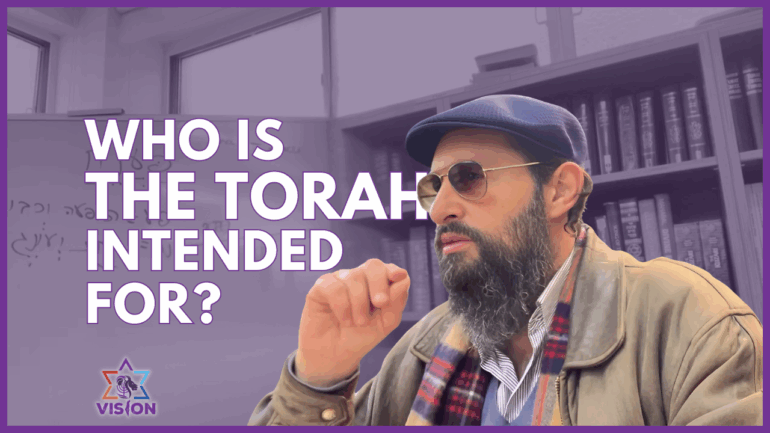
This video explores the nuanced relationship between Israel, the Torah, and humanity.
Key Topics:
► The Torah’s intended audience: humanity vs. Israel
► The Rambam’s distinction between idolaters (Akum) and righteous Gentiles (Bnei Noaḥ)
► Why the Written Torah is meant for humanity and the Oral Torah for Israel
► How Israel co-authors the Torah
► The role of the Torah in fostering ethical behavior and spiritual growth for all peoples
► Misunderstandings by other faiths and the importance of proper access to the Torah