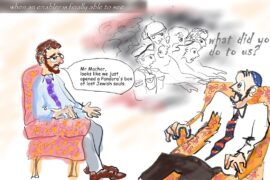
In his landmark book, Orientalism, Palestinian-American author Edward Said describes the phenomenon of “Orientalism,” in part, as the tendency of Western intelligentsia to characterize “the Orient” (including the Semitic region) according to its own limited and exaggerated perceptions.
In doing so, Said argues, the West’s intellectual class facilitates the imperial domination of Semitic peoples and the Semitic region.
Jewish identity is not spared from this phenomenon, but is subject to a unique set of exaggerated perceptions.
Take popular culture as an example. Particularly in the United States, the latest hit series tends to dominate water cooler conversations. To those of us more familiar with the historic relationship between the children of Israel and the fourth empire (Edom – understood as the West in Jewish historiography), Western depictions of Jews noticeably play on predictable stereotypes and culturally accepted notions of the Jewish “Other.”
From the petty neuroses of Larry David to the main character of Unorthodox escaping her oppressive Ḥaredi community in Brooklyn for the “utopia” of blood-soaked Berlin; from the unscrupulous diamond merchant of Uncut Gems to the rogue Reform rabbi of No One Wants This, the notion being reinforced about Jews is that we are weak, unserious, dishonorable, and lacking in any distinct identity or aspirations.
Entire generations of Jews in the US have come to view themselves this way, resulting in a state of auto-alienation.
It’s notable that almost none of the contemporary Jewish themed material in Western popular culture depicts unifying moments of collective Jewish liberation or resistance against oppression and occupation, such as the Maccabean Revolt or the underground struggle for freedom against British rule in Mandate Palestine. Ironically, one of the only recent attempts at doing so came from the notoriously anti-Semitic screenwriter, Mel Gibson, who sought to make a film about the Maccabean Revolt because Sefer Maccabim makes “ripping good reads.”
Can we, therefore, honestly believe that Jewish history simply lacks sufficient material from which to create captivating dramatic films?
The absence of such material can’t be accidental. The US ruling class derives tremendous benefit in the depiction of Jews according to harmful age-old tropes. By diluting Jewish identity and degrading our self-esteem, a psychic fatigue sets in wherein the tropes become internalized, and a manufactured reality is seen as objective truth.
Subsequently, the young Jew being raised in US today is conditioned to see himself as a side character in the story of another civilization instead of as a main character in the story of his own. And behaves accordingly.
This process of auto-alienation, however, cannot be accomplished without the assistance of what the 20th Century post-colonial theorist, Frantz Fanon, describes as a “national bourgeoisie” that emerges among the colonized subject.
Despite belonging to the oppressed group, the national bourgeoise adopts the ideological worldview and culture of the oppressor. An analogy can be made not only between this group and the classically cited Hellenists against whom the Maccabi guerrillas waged war, but also with many contemporary leaders of US Jewish institutions and Jews in leadership positions in American society. It should come as no surprise that while the people of Israel was physically colonized multiple times throughout history, the psycho-spiritual colonization process is still ongoing.
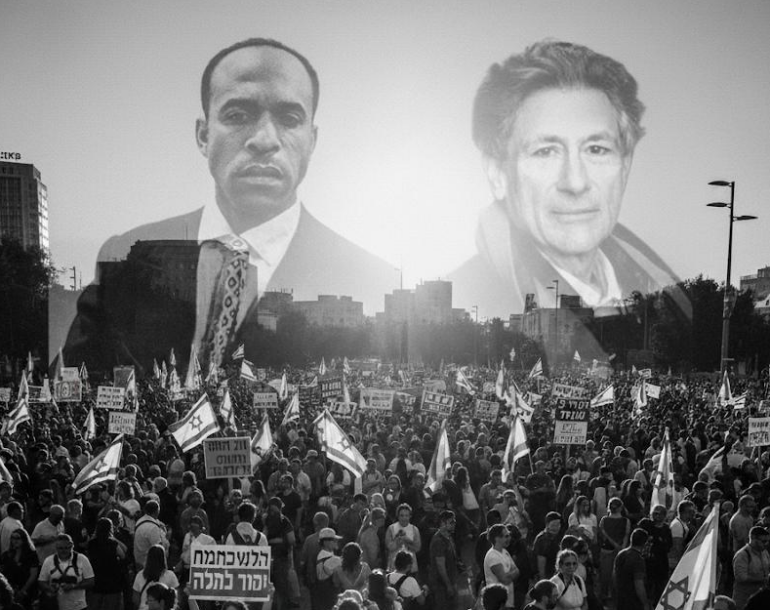
If the matter stopped at entertainment, the collective damage caused by auto-alienation would not be so substantial. But we saw the warped portrayal of our identity take center stage during the pre-October 7 anti-government protests in Israel. Leaving aside genuine concerns many Israelis had, leaders of this movement leveraged American money and power to employ intimidation and sometimes violence to artificially enforce the Western image of what an Israeli, and by extension Jew, should be — a spitting image of a white American gentile.
What ensued was an historic rupture within our people. And who could blame the anti-government protestors? After decades of propaganda promoted by Israel’s national bourgeoisie and their Diaspora supporters, a generation of Jews internalized what Fanon describes as an inferiority complex that increases every time the colonized are reminded that they are Other.
The anti-government protest leaders and their foreign funders, operating as a national bourgeoise, allied themselves with affluent Western conglomerates like the US State Department-funded Movement for Quality Government and the New Israel Fund, whose aims are to de-Judaize Israeli society and partition the land of Israel into two separate states. By targeting Israeli schools and other institutions, this missionary-like endeavor used financial means to undermine Israeli democracy in order to recreate the Jewish people in the image of the oppressor.
The haunting words of Tom Nides, former US Ambassador to Israel, in the summer of 2023 come to mind: “I think most Israelis want the United States to be in their business.”
Nides was concerned that Israel was “going off the rails” – rails constructed and installed by an empire happy to implement neocolonial tactics against an increasingly more Jewishly engaged, Torah-oriented Israeli populace.
Thus does the process of auto-alienation take hold: First, an empire identifies a vulnerable minority population that can serve a geopolitical and/or economic interest.
Next, that population is primed to abandon elements of its culture, folkways, worldview, and core values that contradict the interests of said empire using mass propaganda promoted by a sympathetic national bourgeoise (this process is made easier in Israel’s case due to the fact that so many Israelis had already been disconnected from their identity in exile by centuries of traumatic persecution and desperate efforts to avoid further persecution through adopting the identities of host societies).
Finally, the population is distanced from its true self, consequently neglecting its own interests and aspirations — even viewing them as foreign. The result is full identification of the targeted population with the empire while stunting its own unique potential, purpose, and historical development.
Like our ancestors who descended into Egypt during famine only to wind up its slaves in every sense, the process of auto-alienation has weakened us amidst the rise of lethal anti-Jewish violence in the US and rendered us unprepared to meet the current challenges. Even before the Simḥat Torah massacre of 5783 (2023), attacks against Jews were at an all-time high, especially between 2017 and 2022.
This phenomenon reached its crescendo during the COVID-19 lockdowns when then mayor of New York City, Bill DeBlasio, not only singled out Ḥaredi communities for spreading the virus but did so in a tweet threatening “the Jewish community”.
The dehumanization of Jews emanating from US institutions and public figures culminating in genocidal anti-Jewish rhetoric and attacks was not met by revolutionary activism or organized resistance, but by online outrage pornography and angry letters to officials.
In light of this, no Israeli minister publicly wags a finger at American leaders with concerns about America “going off the rails.”
Anyone who has paid attention to the overall political climate in America has ample reasons to be concerned about derailments. Between the rise of anti-Semitic violence, to corruption charges at the highest levels of government, to indictments of former presidents, to the fact that much of America’s young adult population is saddled with hundreds of thousands of dollars of student debt, to the skyrocketing cost of living, to school shootings and violent crime in inner cities, Uncle Sam has no basis to be concerned about anyone’s train but his own.
An antidote against our ongoing auto-alienation can be found in part of Said’s “thesis of representation,” where he argues that “the Orient” was made visible only through Western techniques of representation and “agreed-upon codes of understanding” instead of by probing the experiences of “Oriental” peoples themselves and allowing them to narrate their own stories. Instead, he proposed a non-coercive and collaborative method of representation (Said, Edward (2001). Viswanathan, Gauri (ed.). Power, Politics, and Culture: Interviews with Edward W. Said. New York: Vintage. p. 12.).
Consider the following statistics. Over forty-five percent of Jews live in Israel, and approximately forty-five percent of those identify as Mizraḥi. Approximately fifty-nine percent of Jews live outside the US and, therefore, are not fully Americanized.
According to Pew Research, young American Jews aged 18 to 29 years old are increasingly identifying as “Orthodox.” Compared with older Jews, younger Jews are either more “Orthodox” or not affiliated with a denomination. Some traditional Jews are likely included in the non-denominational camp. Among Jews who identify with Torah observance, the trend is moving towards greater observance for those under 30.
While polls are difficult to conduct due to the nuances in how Jews self-identify, the overall message is clear: This demographic, often referred to in Israel as “second Israel” (Ḥaredi, Mizraḥi, national-religious Jews, etc. that all experienced marginalization at the hands of “first Israel”), is actually growing worldwide.
Applying Said’s thesis of representation, young Jews – especially of the second Israel variety – should be encouraged to enter spaces in popular culture, academia, journalism, and screenwriting in order to draw upon their own lived experiences and identity for inspiration.
Stories from the Shabbat tables of the Samaria and Judea regions or from the crowds of tens of thousands of Mizraḥi teens who storm the Kotel at midnight for the entire month of Elul to cry out to HaShem during sliḥot must be given expression.
In this moment of reckoning, it is now long past time for the Jewish national bourgeoisie, in Israel and the Diaspora, to stop fighting against second Israel and to shed its role as co-oppressor. In so doing, they can participate in forming the basis of a new Jewish meta-narrative.
Using Said’s framework, to successfully decolonize and rediscover our collective self, the upcoming generation of Jews must claim the microphone, the pen, and the screen so that a reborn people, true to its inner self, will shine its long-stifled light and become what Israel came back to life after centuries of exile to be.