
Groups of people are generally defined by some common unifying factor. When that factor changes, the communal identity also changes (as can the name of the group).
In Parshat Noaḥ, we see identities transform from being “families” to “nations.”
“These are the children of Shem according to their families and their languages, in their lands, and by their nations.” (B’reishit 10:31)
There is a very important difference between families and nations.
Families can easily live in peace with one another. Conflict between them is generally the exception to the rule.
The political nature of a nation, however, tends to be characterized by traits more similar to individuals than to groups. National identity is essentially a form of extended egoism.
While a family can easily welcome in an outsider, “strangers” are experienced by a nation as being external to its identity and a potential threat.
The natural relationship between nations is therefore a state of war, with peace being so unusual that the prophet views it as noteworthy.
“Nation will not lift sword against nation.” (Yeshayahu 2:4)
What is the source of this difference between families and nations?
The verse quoted above implies that when a group is defined by cultural factors – by “their languages” – it can be characterized as a family. But when that group becomes defined by territory – “in their lands” – the entity becomes a nation.
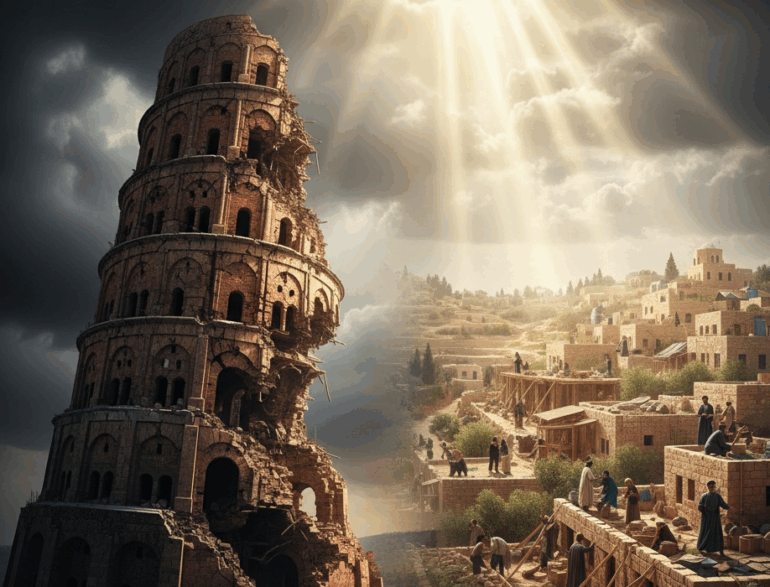
In reaction to the dissent of humanity from families to nations and the conflicts that ensued, two experiments were attempted to prevent war: Nimrod’s Tower of Babel and the Divine selection of our ancestor Avraham to sire a Hebrew nation.
The Tower of Babel was an attempt to cancel out the differences between peoples – the people had “one language” (B’reishit 11:1).
The word used in this verse for “language” is “safa” rather than “lashon.”
In addition to both words meaning “language,” “safa” also means “lip” while “lashon” also means “tongue.” The implication is that the word lashon (as used in B’reishit 10:31) means something deeper and more internal than mere words and should also be understood to include culture. So while lashon relates to internal – even spiritual – content, safa remains external and superficial.
The Tower of Babel was a cosmopolitan attempt to enlist humanity in a shared project that actually sought to replace the individual identities of its participants with a superficial shared identity. Nimrod’s aim was to ultimately erase deep differences and remove that which would cause groups to fight one another. But erasing the deep identities of peoples ultimately serves to eradicate the intrinsic value of human beings.
Divine revelation, by contrast, doesn’t blur individuality. In fact, it enhances each group’s unique characteristics – so much so that people could no longer understand the language of others. And in this way, humanity was rescued from the hell of absolute uniformity.
In the wake of the Tower of Babel’s failure, Avraham was given a Divine mission. He wasn’t instructed to erase the identities of the nations, but rather to revert the nations back to their former status as families.
This mission could only be accomplished through establishing a new type of national identity, “a great nation” (B’reishit 12:2), whose sole purpose is to remove the idea of nationality and to bring humanity back to the status of families: “And all the families of the earth will be blessed through you” (B’reishit 12:3).
What this actually means is that the nation of Israel is actually the only legitimate national identity. While other nations exist as a form of extended egoism and merely seek to benefit themselves at the expense of others, Israel’s national purpose is to heal and reunite humanity.
The ideal future reality revealed to us by the prophecy of Zekharia is that “all who remain from all the nations which invaded Jerusalem” (Zekharia 14:16) will become families.
“Those who do not come from among the families of the earth… and if the family of Egypt will not come…” (Zekharia 14:17-18].
Humanity is destined for unity. Not for cosmopolitan uniformity or divisive rival nationalisms, but for a form of Divine unity that prophetically harmonizes deep cultural differences.
All the peoples, each one with its own unique character, will go up “to the Mountain of HaShem, the House of the G-d of Yaakov, He will teach us of his ways and we will go on his path, for the Torah will emanate from Zion and the word of HaShem from Jerusalem.” (Yeshayahu 2:3)
Translation by Dr. Moshe Goldberg