
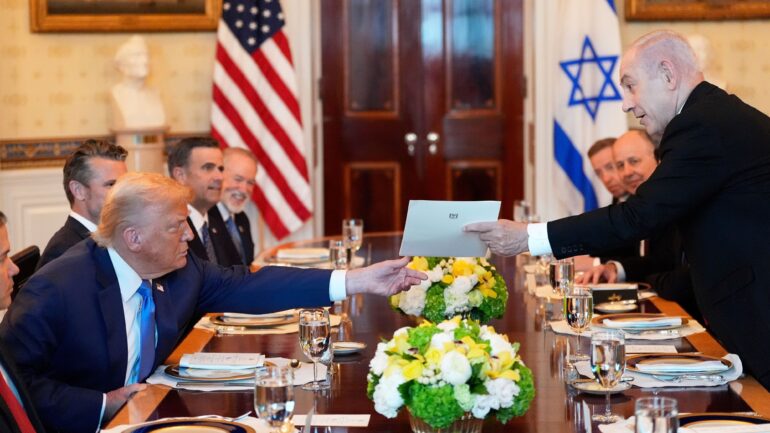
On his recent trip to Washington, Prime Minister Binyamin Netanyahu (Likud) made a show of nominating US President Donald Trump for a Nobel Peace Prize.
In a formal letter presented to Trump, Netanyahu hailed the president’s leadership in brokering the Abraham Accords, calling the 2020 Arab-Israeli cooperation agreement an “historic advance toward peace, security, and regional stability.”
Yet to the surprise of many observers, Netanyahu left Washington without signing any new deals. Despite his high praise for the original accords, he resisted getting prematurely drawn into a new agreement.
It was a deft balancing act by the Israeli leader that underscores a paradoxical truth about the new regional order created by Israel’s joint attack with the US on Iran’s nuclear facilities. While many Israelis see “normalization” as the reward for our military victories, Israel’s strength as a regional power now depends on resisting the allure of deals that demand significant concessions — either to Washington or our neighbors — but offer no concrete benefits in return.
To understand why a new Abraham Accords could be a trap for Israel, it’s necessary to revisit the logic of the original agreement and then examine what has changed.
Going into the original deal, Israel was strategically surrounded by a network of Iranian proxy groups. The so-called “ring of fire” encircling Israel emanated from Tehran and included the Houthis in Yemen, Shia militias in Iraq, Bashar al Assad’s regime in Syria, Hezbollah in Lebanon, and Hamas in Gaza.
For much of the past fifteen years, Iran had expanded its regional hegemony under the direct sponsorship of the United States.
Over two administrations, the main plank of US foreign policy under President Barack Obama was to elevate Iran’s position in the Semitic region and turn it into a strategic center of power.
The theory among Washington officials at the time was that Israel and Saudi Arabia were continually pulling the US into conflicts in west Asia. They looked for a solution that would stabilize the region and maintain US dominance over it without requiring direct military intervention. Their answer was to engineer a new balance of power based on ruling through client states. By making Iran stronger while weakening Israel and Saudi Arabia, they hoped to achieve a rough equilibrium between the opposing forces.
This doctrine ultimately became known as “the realignment.” It clearly failed to make the region more stable as promised, but it markedly enhanced Iran’s power by turning Tehran into Washington’s primary strategic partner in west Asia.
The purpose of the Abraham Accords was to reverse the pro-Iran realignment by linking up all of Iran’s regional adversaries. Other elements of the deal, like increased business and cultural ties, which built on pre-existing informal relationships, were accessories to the essential security imperative of containing Iranian expansionism.
But even in 2020, the accords posed significant risks to Israel.
They included plans to partition Israel into two separate states according to the guidelines of Trump’s “Deal of the Century.”
While Saudi Arabia acted as a silent partner to the agreement between Israel and the Sunni Arab states who joined the accords, it declined to formally enter the deal.
Saudi participation was held out as a reward for a later stage. The idea was that the Sunni kingdom would only become a signatory to the accords and implement formal relations with Israel, contingent on the creation of a Palestinian state administered by the Western-backed Palestinian Authority with Saudi backing.
In other words, normalcy would be a gift bestowed on Israel in return for relinquishing its internal sovereignty – both in terms of policy making autonomy and territory.
For Netanyahu, who signed the original accords, their risks were outweighed by the need to break Iran’s ring of fire.
But Israel is in a radically different position today than it was in 2020.
For that matter, so is the rest of the Semitic region. Israel single-handedly bludgeoned Iran’s proxy network while dismantling the Iranian capacity to project any significant military power. Add to that the ouster of the Iranian-aligned regime in Syria and its replacement by a Turkish-backed Sunni Islamist party and it becomes clear that Iran’s era as a regional kingmaker is over.
In consequence, the main logic behind the original Abraham Accords is no longer relevant and exists only as the relic of a bygone period.
Many Israelis and people in the pro-Israel community have been slow to catch up to this new reality. Though it is staring them in the face, they have a hard time accepting that Israel is now the main regional power in west Asia. They continue to pine for a US-led normalization agreement because they persist in seeing Israel as vulnerable and in need of external validation and support.
Moreover, they fail to see how such deals and offers of “regional integration” are continually used to curb Israel’s power and subvert our independence, as happened with the recent maritime deal made with Lebanon.
Likewise, despite the fundamental transformations of the Semitic region, some of Israel’s neighbors still speak publicly as if they were stuck in the past.
Saudi Arabia, for instance, continues to dangle the prospect of normalizing ties with Israel in return for Israeli acquiescence to a Saudi-sponsored Palestinian state. Yet, the Saudis have not made the case for what exactly is so valuable about “normalcy” with them.
The context that made the original prospect of an Israeli-Saudi alliance compelling for Israelis no longer exists because Jerusalem erased it. The notion that Israel should now have to pay tribute to the Saudis, or anyone else, for having redrawn the board is delusional. If anything, the Saudis owe a debt to Israel for having defanged their primary adversary in Tehran.
This is not to say that there are no good reasons for Israel to enter into partnerships with our Arab neighbors. Security cooperation over Syria to prevent tensions there from spilling over, is only one of many possible reasons. The point, however, is that such partnerships are only as good as the real benefits they offer, and in the new regional context it’s Israel that has most of the leverage.
Thankfully, Prime Minister Netanyahu not only seems to understand this but has demonstrated a degree of nimbleness that is uncommonly impressive for a man of his age.
Netanyahu’s balancing act, requires flattering Trump and maintaining good relations with Washington while not being drawn into deals that would compel Israel to make real sacrifices in exchange for only symbolic benefits.
The prime minister’s success will be measured more by the deals he doesn’t sign than by those he does.