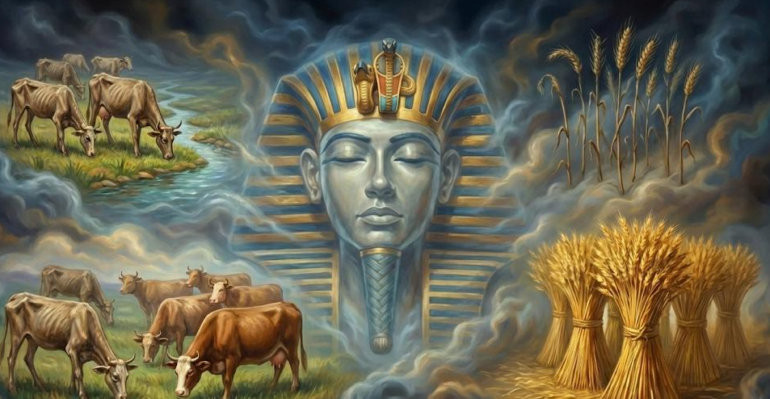
It took Pharaoh two years until he dreamt a dream.
The Book of B’reishit is full of dreams and it’s clear that these dreams possess traits of a prophecy.
Within the Hebrew family of Avraham, Yitzḥak, and Yaakov, dreams appeared as a unique ability that could be transferred to others with whom they came into close proximity.
Avimelekh began to dream after Avraham and Sarah arrived in his kingdom.
Yosef, the dreamer, caused the people in his Egyptian prison to dream. And when one of them, the minister of cupbearers, was released and moved to the house of Pharaoh, the monarch also began to dream.
The meaning of Pharaoh’s dream seems so simple and obvious to us today that it’s difficult to understand why the wise men and sorcerers of Egypt couldn’t explain it.
When Yosef ultimately provided the explanation, he was told, “after G-d has told you all of this, nobody is more understanding and wiser than you are” (B’reishit 41:39).
Every child should be expected to understand that the fact that the cows and the crops initially being fat but then becoming lean as meaning that there would be an abundance of food followed by famine.
Furthermore, the number seven referring to a number of years should have been obvious due to the fact that the same word was used for “cow” and “year” in the Egyptian language.
But an understanding of ancient Egyptian society can help us appreciate why Pharaoh’s courtiers couldn’t see the dream’s meaning.
In order for a famine to occur in Egypt, it would be necessary for the Nile to stop fulfilling its normal function. This was unthinkable, since the Egyptians related to the Nile as a deity.
The gods in Egypt were the forces of nature, which were related to in a deeply religious fashion. This meant that these natural forces became absolute values. Egypt was a mental “house of bondage” in every way, since nothing in the land could ever divert from its deterministic function.
Everyone was a slave: the slaves belonged to their masters, the masters were slaves of Pharaoh, Pharaoh was a slave of the gods, and the gods were slaves of nature. Any notion of change was simply impossible to fathom.
How, then, was Pharaoh able to dream about change?
It was because he was influenced by the presence of a Hebrew in his midst. That’s why he was able to deviate from the ideological paradigm imposed on him by the Egyptian culture and to have this rare opportunity to bring the influence of Avraham in its midst.
Pharaoh became sensitive to the language of Yosef, and he therefore put him at the top of the Egyptian pyramid.
This unique occurrence of cooperation between the Hebrew culture and the general international culture (led by Egypt) caused Yosef to believe that he would be able to separate his brother Binyamin from the children of Leah and take him on as a partner in Egypt.
This explains the affair surrounding Yosef’s goblet, which was meant to completely sever Binyamin from his brothers so that they would agree to leave him behind in Egypt as a slave (this took place before Yosef understood that he was subconsciously working to bring his brothers to complete tshuva over what they had done to him).
It was ultimately Yehuda’s willingness to sacrifice himself for Binyamin that prevented Israel’s division at that early stage in our development, because it displayed that the trait of mutual responsibility had grown into a central value amongst Yosef’s brothers.
Translation by Dr. Moshe Goldberg