The laws of the Korban Pesaḥ differ from those of other korbanot.
The Pesaḥ offering is the only one brought by an individual that also shares some of the characteristics of a public offering.
Like public offerings, the Korban Pesaḥ it is brought on a specific date and therefore takes precedence over the laws of Shabbat. It is also eaten in a large group of people – by the crowds of the many pilgrims that come to Jerusalem for the festival.
This duality is a result of the fact that the Pesaḥ festival celebrates the birth of Israel – the Hebrew nation – as a political entity.
At that great moment, a unique act of ḥesed could be felt, and a portion of Israel’s national soul was infused within every individual Israelite. Every individual had an added value as part of the larger national collective.
Although individual Israelites generally lack the ability to separate themselves from the general fate of the collective nation (a Jew can’t stop being a Jew), at the time of the Exodus from Egypt every person had the opportunity to decide whether or not to become part of Israel and its history. This is actually the meaning of the response to the “wicked son” in the Pesaḥ Haggaddah (when he attempts to separate himself from Israel): “If he had been there, he would not have been redeemed.”
At that point in time, it was actually possible for an Israelite to decide not to be redeemed. But in the present, we have no such choice and we therefore have a sacred duty to fulfill Israel’s destiny.
There was also another unique aspect to that first Pesaḥ in Egypt at the time of the Exodus.
When Israel has an Altar for atonement and a Temple, the blood of the Korban Pesaḥ is sprinkled on the sides of the Altar. But in Egypt, the children of Israel were commanded to dip a hyssop into the blood in the basin (where the blood of the korbanot was collected), and to spread it out over the entrance to their homes.
This was clearly symbolic – the house takes the place of the Altar, and the lintel and doorposts played the part of the sides and corners of the Altar. This was therefore the only time that the flesh of the korban was eaten not outside the confines of the Altar, but rather within the area of the Altar itself.
We thus see that in the very beginning of our national history, the exalted status of the Altar was revealed in the act of eating.
This would eventually become understood as the concept of sanctity embedded within nature – something that would be elucidated by the generation of the footsteps of the Mashiaḥ, as was explained by HaRav Avraham Yitzḥak HaKohen Kook (Orot HaKodesh II, HaKodesh HaKlali 23).
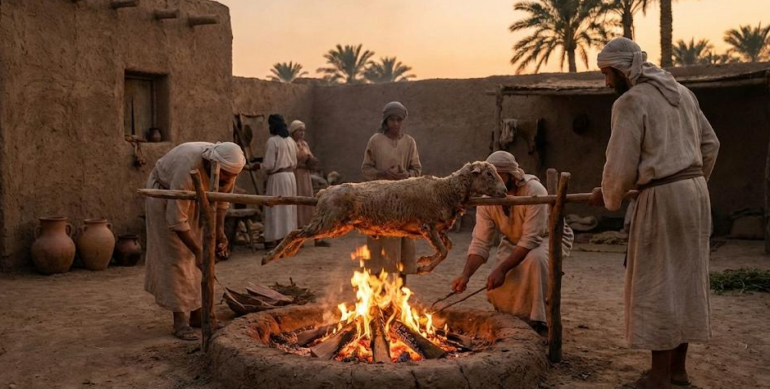
The Korban Pesaḥ is a lamb, worshipped by the Egyptians as a deity. It was eaten by the children of Israel before departing Egypt. The very act of eating this lamb on the eve of the Exodus leading to freedom symbolizes the consumption and internalization of those Egyptian values that were worthy of being redeemed as part of Israel’s redemption.
These are the sparks of sanctity that exist within the framework of the general culture of the world, and they are absorbed as part of the formation of Israel’s identity, which includes within it features shared in common with all other nations.
“He set the borders of the nations to be equal to the number of the children of Israel.” (D’varim 32:8)
The Korban Pesaḥ is brought when the moon is full, in the month that marks the beginning of spring. This is the time of rejuvenation, and it is the most appropriate time for the greatest act of renewal in human history: the creation of Israel.
The word for basin is “saf” – which can be understood as an “opening” or expanded into “sefel” (“cup”).
The basin, in which the blood of the korbanot was powerfully transformed into the Divine Will, can also be seen as the opening for the historical process leading to the healing and perfection of the entire world.
Translation by Dr. Moshe Goldberg