Josh Rosenstein, a successful investment bank employee, arrived at his office on the 87th floor of the North Tower of the World Trade Center on September 11, 2001.
He had enough time to drink coffee and respond to a few emails when a powerful explosion shook the entire building.
A plane had crashed into the tower, several floors above him. Chaos erupted. The smell of smoke, screams, and panicked people desperately trying to find an escape route filled the air.
Josh, one of the few who maintained relative composure, began descending the emergency stairs, floor by floor, through heavy smoke and debris. Hours of slow, nerve-wracking descent, with the second tower collapsing in the background, ended when he emerged, covered in ash, into an apocalyptic scene of destruction.
Josh survived. But for countless others, that day became their last.
The event, which saw the collapse of the Twin Towers and the alteration of the New York City skyline, etched itself into the global consciousness not just as a horrific act of terror, but as a dramatic turning point. It was an earthquake that revealed deeper processes – a clash between civilizations and between different worldviews regarding the place of humanity, faith, and justice in the world.
The event, whose repercussions continue to echo and influence recent global developments, serves as an excellent starting point for exploring an ancient Hebrew concept that offers a unique understanding of the forces at play in the world and presents a vision of hope for the future.
Our sages, particularly the Maharal of Prague, explore the forces that vie for control of the world, as well as the struggles between them. They identify three central “kingdoms” or civilizations that largely shape the course of history: the kingdom of “Edom” (primarily representing Western civilization, deeply influenced by Christianity and ancient Greek philosophy), the kingdom of “Persia” (representing the Islamic world, which is also seen as a continuation of the Biblical Ishmaelites), and finally the people of Israel, who possess a unique and pivotal role.
The Maharal draws upon ancient stories from the Talmud, the foundational text of Jewish law and lore, which contain deep symbolic meanings that transcend their historical context.
Edom (The Modern West): Material Abundance and Moral Justification
When the Talmudic sages describe the kingdom of Edom, they imagine it appearing before the Creator and boasting: “Master of the Universe, I have established all the marketplaces, I have built all the bathhouses, I have amassed all the silver and gold.”
The Maharal interprets this description as an allusion to this civilization’s primary focus on material progress, economic prosperity, technological advancement, and the construction of a vast global infrastructure.
This emphasis is clearly visible in the United States, the current leader of Western civilization. The Twin Towers were an undeniable symbol of US economic power – a global trade hub representing immense wealth and connecting people through commerce.
As the Talmudic story continues, the kingdom of Edom adds a striking claim: “All this I did only for the sake of Israel, so that they might engage in Torah.”
This is a fascinating assertion. The West not only expands materially but also presents its actions as serving a higher purpose – ensuring stability and prosperity, thereby enabling other nations (including Israel) to develop spiritually and intellectually.
The Maharal, with his keen spiritual insight, reveals the underlying truth behind this claim: “The Holy One, Blessed be He, replies that it did not do this for the sake of Israel… for they spread out materially… and this is why they achieve ultimate expansion to the ends of the world.”
In simpler terms, the Creator clarifies that despite the rhetoric of universal values and concern for humanity, Edom’s true objective is self-advancement, widespread influence, and power. Progress and economic development, while seemingly beneficial for all, are often means of establishing Western control and dominance.
Indeed, the attack on the Twin Towers was an assault on this very symbol of Western power, a consequence of a view that saw this expansion not as more of a threat than a blessing.
This point gains particular relevance in recent days, given the ongoing struggle between the State of Israel and the Islamic Republic of Iran, which is the modern expression of Persia.
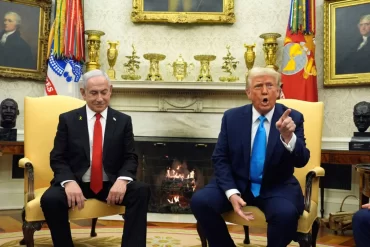
As Israel faces escalating threats from Iran – be it through its nuclear ambitions, regional proxies, or subversive activities – the question of American involvement arises. As the leader of the “free world” and the current leader of Edom, Washington’s deliberations generally revolve around the justification of “America’s best interests.”
Will military, economic, or diplomatic intervention serve the US national interest? Will it harm the economy? Will it cost American lives? This is a clear manifestation of the Maharal’s insight: general “concern” – even for a supposed ally like Israel – is primarily subservient to the dominant power’s considerations of the self-interest.
Persia (The Muslim World): The Warlike Force and Spiritual Justification
Immediately after Edom, the kingdom of Persia (representing the Islamic world) enters, proudly declaring: “We have built bridges… we have conquered cities… we have waged wars…”
The Maharal explains that these actions express assertiveness, territorial conquest, expansion by force of arms, and the imposition of order through warfare.
This more aggressive character aims to imprint its physical and authoritative mark on the world. Organizations like al-Qaeda that carried out the 9/11 attacks are a clear modern manifestation of this force. They view war as a means to achieve religious and political objectives, intended to complete a “global revolution” or establish a worldwide caliphate.
Persia, like Edom, also claims spiritual legitimacy: “All this I did only for the sake of Israel, so that they might engage in Torah.”
That is, this aggressive force also presents its actions as having moral justification – for example, the Muslim concept of “Jihad” (holy struggle), which is presented as not only an internal battle against negative inclinations but also as a battle for the defense of Islam and the establishment of a more just world according to its principles.
But again, the Maharal does not accept the justification: “The Holy One, Blessed be He, replies that it did not do this for the sake of Israel…”
The Persian kingdom’s actions stem from a relentless pursuit of power and the imposition of its own agenda, rather than genuine concern for others. The attacks were a dramatic attempt by this force to shock the world, strike at the symbol of Western power, and raise its flag.
The current struggle between Israel and Iran vividly illustrates this.
Iran, with its nuclear aspirations, its support for militant organizations like Hezbollah and Hamas, and its intervention throughout the Semitic region, presents itself as acting for “Islamic justice” and for the liberation of “oppressed peoples” (which often explicitly means the destruction of the State of Israel). But in practice, its actions are designed to establish its regional hegemony and expand its politico-religious influence, leading to chaos and instability.
This is a clear manifestation of the “kingdom of Persia” described in the Talmud: a force that operates aggressively, expands, and dominates, but masks its actions with moral and spiritual justifications.
An Ancient Struggle: Jerusalem at the Center of the Conflict
The conflict between Edom and Persia is not new. It has resonated throughout history in various forms, and Jerusalem, the eternal capital of Israel, has often been at its heart.
A striking example of this is the era of the Crusades. The epic struggle between Saladin, a great Muslim leader who established a vast empire, and King Richard the Lion heart of England, revolved entirely around the control of Jerusalem.
Saladin, as a clear representative of Persia/Ishmael during that period, viewed conquering Jerusalem from the Crusaders as a holy war (jihad) aimed at restoring the “honor of Islam” and Muslim holy sites into his hands. His actions, including aggressive wars, were explained as being for the sake of a religious ideal.
King Richard, on the other hand, led the Third Crusade with the intention of freeing Jerusalem from Muslim rule and restoring it to Christian hands. His actions, though often brutal and frequently motivated by political and economic interests, were also explained as a “holy war” for the sake of Christianity.
This medieval struggle over the very core of sanctity – Jerusalem – reflects the same dynamic that led to the 9/11 attacks and even to the contemporary conflicts between Iran and the West. Edom and Persia each see themselves as the defenders of Divine truth and justice. They are willing to fight ferociously to imprint their mark on the world, all while using religious justifications for domination and expansion.
Jerusalem, which was then a physical battlefield, has today become a symbol of the ongoing cultural-religious struggle, with each side claiming exclusive rights over it and what it represents.
The Eternal Struggle: “These and These Persist in Their Kingdom”
The Talmud concludes the struggle between Edom and Persia with a profoundly meaningful statement: “These and these persist in their kingdom until the Messiah comes” – both the West and the warring Muslim world “persist in their kingdom.”
This means that they both continue to rule and contend with each other, and this conflict will persist until the coming of the Messiah.
The 9/11 attack and the “War on Terror” that began in its wake, as well as the geopolitical and military struggles of our current day in West Asia and around the world, including the historical struggle over Jerusalem, have illustrated the deep ongoing conflict between these two super-cultures.
It is a struggle for control, for values, and for the future of the world, and it appears to have no solution solely on the physical or political plane.
Israel: The Balancing Light and Unique Partnership
Within this global struggle, our ancient texts present a third and unique position – that of the Hebrews.
Unlike Edom, which places humans at the center, and Persia, which places God at the center, Israel places the dialogue between the Creator and humanity at the center.
Humanity is not a peripheral being blindly submitting, nor is it the sole master of the universe. It is an active partner with the Creator in perfecting His creation.
The return of the Jewish people to our land and the establishment of the State of Israel are part of the realization of this partnership – the Sh’khina (Divine Presence) returns to dwell amongst its people, transforming Israel into a focal point for a renewed connection between heaven and earth.
In the realm of values, too, Israel offers a crucial balance.
While Christianity emphasizes compassion and Islam emphasizes justice, Israel’s Torah teaches the integration of “doing charity and justice” together. This is a message of balance, of mercy alongside truth, of righteousness alongside compassion. The Torah emphasizes that this must be evident even in Israel’s conduct in wartime and in our treatment of minority populations. We must strive to uphold high moral principles.
Israel’s mission is not to coerce humanity or to dominate others, but rather to serve as “a light unto the nations.”
This is a role of profound responsibility, not of superiority. Israel offers guidance and a way of life, particularly through the “Noaḥide laws” – a universal system of ethical and spiritual principles that allows every person, from any culture, to live a moral and spiritually fulfilling life based on Divine revelation, without abandoning their unique identity.
The prophet Yeshayahu declared, “For out of Zion shall go forth the law, and the word of HaShem from Jerusalem.”
This is a vision in which all nations will ascend to Jerusalem, not to adopt a new identity, but to receive inspiration and guidance that will be tailored to their own unique identities.
We currently find ourselves living in an era where conflicts are more complicated than ever, and political and military solutions alone are insufficient.
The Hebrew path offers a fundamental solution – a renewed connection to a universal moral and spiritual framework. If you feel confusion or emptiness, and are searching for a meaningful way to live your life in partnership with the Creator and in peace with humanity, you are invited to learn more about the Noaḥide laws or to take a real step towards a deeper connection with your purpose by clicking here and signing up to our upcoming declaration.
Hope in an Age of Uncertainty
In a world where events like 9/11 exposed the depth of hatred and destruction, and where we continue to witness ongoing struggles that leave us feeling confused and empty, the Hebrew message offers a ray of light.
Instead of an endless battle between extremes, it proposes dialogue, partnership, and balance. Instead of coercion and domination, it offers guidance and inspiration, all while respecting cultural diversity.
Redemption, according to this perspective, is not merely the cessation of wars, but also a profound transformation in how humanity perceives itself and its place in the world.
The Jewish people, in our return to our land, offer not only a solution to conflicts but also a path to a meaningful life, where physical and spiritual existence harmonize.
This is an invitation to all of humanity – to all the “families of the earth” – to discover the blessing inherent in genuine cooperation and receiving Divine guidance in ways that honor the rich tapestry of the human experience.
We offer hope for a world where peace is not merely the absence of war, but a deep connection between humanity and the Creator, as well as between all human beings with one another. Don’t wait for the world to change by itself – be a part of changing it – in partnership with Israel.