
For decades, Iran was the convergence point.
United States oil and national security interests dictated an anti-regime policy since the Islamic Revolution of 1979.
At the same time, Iran’s aggressive rhetoric, combined with the advancement of its nuclear program and hostile proxy network, presented an existential threat to Israel.
For this reason, AIPAC and others interested in tying the fates of Israel and the United States heavily focused on the Iranian threat.
In the early hours of June 22, when the United States entered Israel’s war against Iran, these forces celebrated a great victory.
After what appeared to be stunning betrayals from what was meant to be the “most pro-Israel administration” in American history, the bond appears to have been restored. When it counted, the US had Israel’s back. This was reinforced when the US president ensured there was no ambiguity: “we’ve gone a long way to erasing this horrible threat to Israel.”
But behind this celebration lies a deeper threat: a psychological dependency on American power that confuses support for sovereignty with support for servitude. By embracing the “royal we” that Washington has offered, Jerusalem dangerously compromise our own identity, independence, and ability to define our own interests.
First, we must address the fact that Iran’s rhetoric against Israel has traditionally been inspired by the relationship that Jerusalem has to Iran’s number one enemy, the United States. Iran’s 1979 revolution gained popular support thanks in large part to the meddling of foreign powers in the region.
The CIA’s 1953 coup d’état that removed Iranian Prime Minister Mohammad Mosaddegh from office – because he had threatened Western oil interests – set the stage for the present regime’s legitimacy.
After the coup, the Shah, himself a relic of British imperialism during World War II, was handed more power and ruled with an iron fist. He imposed economic and social reforms designed to westernize Iran. Women were forbidden to wear hijabs in public and growing wealth gaps in Iran began to mirror those of the United States.
These conditions empowered a coalition of Marxists, Islamists, and Iranian nationalists to seize power and radically transform the country.
Israel’s close relationship with the Shah’s regime and with its benefactors in Washington, painted a target on the Jewish state. For the Islamic Republic of Iran, empowered with its new theocratic constitution penned by the face of the revolution, Ayatollah Khomeini, the United States was a “Great Satan” and Israel was the junior partner – the “Little Satan.”
This role is one often embraced by supporters of the US-Israel relationship. Ben Shapiro once summarized the Islamic world’s rejection of Israel by saying that they don’t hate the West because of Israel but actually “hate Israel because they hate the West.”
Intended to portray Israel as an American proxy in West Asia and to justify US support, Shapiro’s quote inadvertently clarified the core grievance: Israel’s betrayal of its own identity through choosing to side with a hostile imperialist power in the region.
A Jewish desire to attach ourselves to a powerful protector, birthed from centuries of traumatic persecution, converges with an American interest in a subjugated Israel to US imperialist interests. While maintaining an official pro-Israel stance, Trump has signaled that Israel depends on Washington for security while simultaneously celebrating Israeli victories as American ones.
Boasting that “We Now Have Complete and Total Control Over Iran’s Skies,” Trump effectively claimed credit for Israeli airstrikes. He even used strikes to try and leverage Iran to return to negotiations, where Trump has already proposed an updated version of Barack Obama’s JCPOA nuclear deal as a containment strategy.
The royal we was employed beyond President Donald Trump himself. In a revealing discussion between two far right American public figures, hawkish Senator Ted Cruz and isolationist pundit Tucker Carlson sparred on American involvement in Israel’s war with Iran.
“We’re carrying out strikes against them today!” Cruz said in the heated exchange.
Carlson sought clarification, “you said Israel was…”
“Yes, Israel is, with our help.” Cruz clarified as though it were a negligible difference.
Other Trump allies have also made the case against intervention in Israel’s conflict with Iran. Not out of a moral concern, but as a matter of principle – to challenge the royal we from a place of hostile American nationalism.
Trump allies like Matt Gaetz, Tucker Carlson, Marjorie Taylor Greene, and even Candace Owens have become outspoken against this marriage of interests purported by pro-Israel advocates and lobbyists.
On his show, Gaetz called out “Israel’s foreign policy seduction of the United States” and expressed hope that Donald Trump would live up to his campaign promises to de-escalate conflicts and become a peace maker. He then called for both Israel and Iran to dismantle their nuclear programs.
The isolationists favor retreating from the world stage. They seek clear boundaries between US and Israeli interests. They have questioned the role that Israel has played in American foreign policy-making over the decades, leading to a discourse on the American right that frightens US Jews.
In the battle between isolationists and the traditionally hawkish Republican establishment, Israelis and pro-Israel US Jews find themselves on shaky ground, and are doubling down on efforts to secure support from the hawkish Republicans.
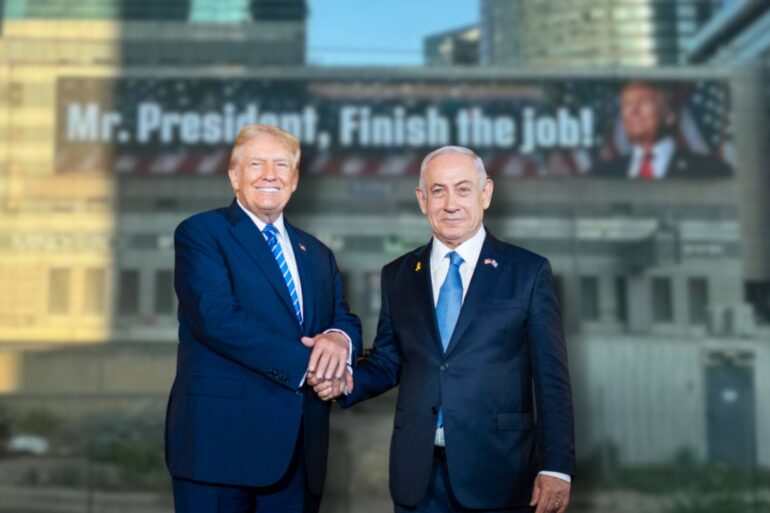
In a recent op-ed, former Israeli Defense Minister Yoav Gallant (Likud) called on Washington to help Israel “finish the job.” And Trump’s strike was celebrated by many Israelis and pro-Israel Diaspora Jews as a victory for the “free world.”
But we must resist the temptation to buy into this perspective.
This position, championed by figures like Ted Cruz, Lindsey Graham, and other hawks, seeks to advance US imperial interests through military means whenever possible. It views Israel not as a sovereign ally, but as an extension of American power: “the largest American aircraft carrier in the world.”
US participation in the war, especially as a favor to Israel, may not only further subordinate Jerusalem to Washington’s regional agenda. It also risks reinforcing an internal Jewish misconception that Israel and the United States are part of a some shared civilization.
Trump frequently presents Israel as dependent on Uncle Sam, as if the notion of Israel defeating Iran alone would itself pose some kind of threat to US interests.
When asked if the US will participate in the strikes against the Islamic Republic, Trump praised Israel’s June 13 actions, but called them unsustainable. It was also leaked that the US president urged Netanyahu not to strike Iran for weeks before, and that he vetoed an Israeli operation to assassinate Supreme Leader Ali Khamenei.
While many in the Diaspora pro-Israel space celebrate Trump and are unbothered by American politicians utilizing the royal we to celebrate Israeli military success, this attitude only strengthens Israel’s subservience to the US Empire. We shouldn’t seek a pro-Israel leader in Washington, but rather a free and independent Israel.
This dilemma reflects a tension that actually predates the existence of the United States. It is Christendom’s ongoing struggle with the existence of the Jew, now projected onto the international stage, featuring Israel as the Jew among the nations.
In the 4th Century, Augustine of Hippo created a theological framework that permitted Jewish existence, but only in a subservient, humiliated, and marginalized role within Western civilization – as a witnesses to Christian supremacy, the Jew plays a key role in Christian eschatology.
We were to survive, but never thrive. To be used. Preserved, but in exile. Protected, but in degradation. This would be fundamental to the roles Jews would be forced to take in Medieval Europe and the modern United States.
Augustine’s doctrine would be echoed through Martin Luther’s Protestant Reformation, through the Catholic Church’s Vatican II, and now through the polite imperialism of “pro-Israel” US foreign policy.
These ideas are somewhat mirrored in how our sages describe the relationship between Esav and Yaakov (representing Western civilization and Israel respectively). The Talmud (Megilla 6a) clarifies that we should distrust anyone trying to claim that both Esav and Yaakov could be and is framed as one that can be sold to an unwitting person.
As many Jews were quick to point out last week, our people have experienced a victory in Iran once before.
In Megilla 14a, our sages discuss the events chronicled in the Scroll of Esther and seek to answer an imperative question: Why is it that after Israel’s miraculous victory, we don’t recite Hallel?
The Talmud offers several complementary answers but we should focus on one in particular: “We were still servants to Aḥashverosh.”
In other words, while we beat the anti-Semites, we were still subservient to the empire. It was, as the Ramban would teach us centuries later, not a national liberation.
Celebrating the hawks of the Republican party, or US participation in this war, reveals a slavish mentality to Christendom that exposes an existential psychological danger to the people of Israel.
While there may be a temporary convergence of interests, it’s a far cry from a united front with shared values or a shared worldview. Israel should of course exploit every opportunity to win this war, but winning cannot come at the expense of losing ourselves.





I really like this article from Shai Hershel; however, I consider this comment more fitting for the currently-featured article, The Challenge of Jewish Indigeneity, where the comments are now closed. Israel must also be freed from the Muslims here in the Semitic region of the world.
Could it be that all it takes is our leadership understanding that they are contributing to this major dysfunction? And how would this be most likely to occur?
I was ready to post something about dhimmitude, as though this site had never heard of it; but, then, HQB”H showed me the comments in the above-mentioned article. I’m glad I don’t have to make the argument, except to add myself as being descended from both paradigms.
That said, my question is: How do we know that, on some level, the US isn’t also cooperating with Iran? It’s in both their interests to keep us in thrall, whether together or separately; that is, to keep us small and dependent on them, each in its own way.
May God give us the courage to direct our energies towards our freedom from both of them. “A plague on both their houses!” as they say.